What we conclude
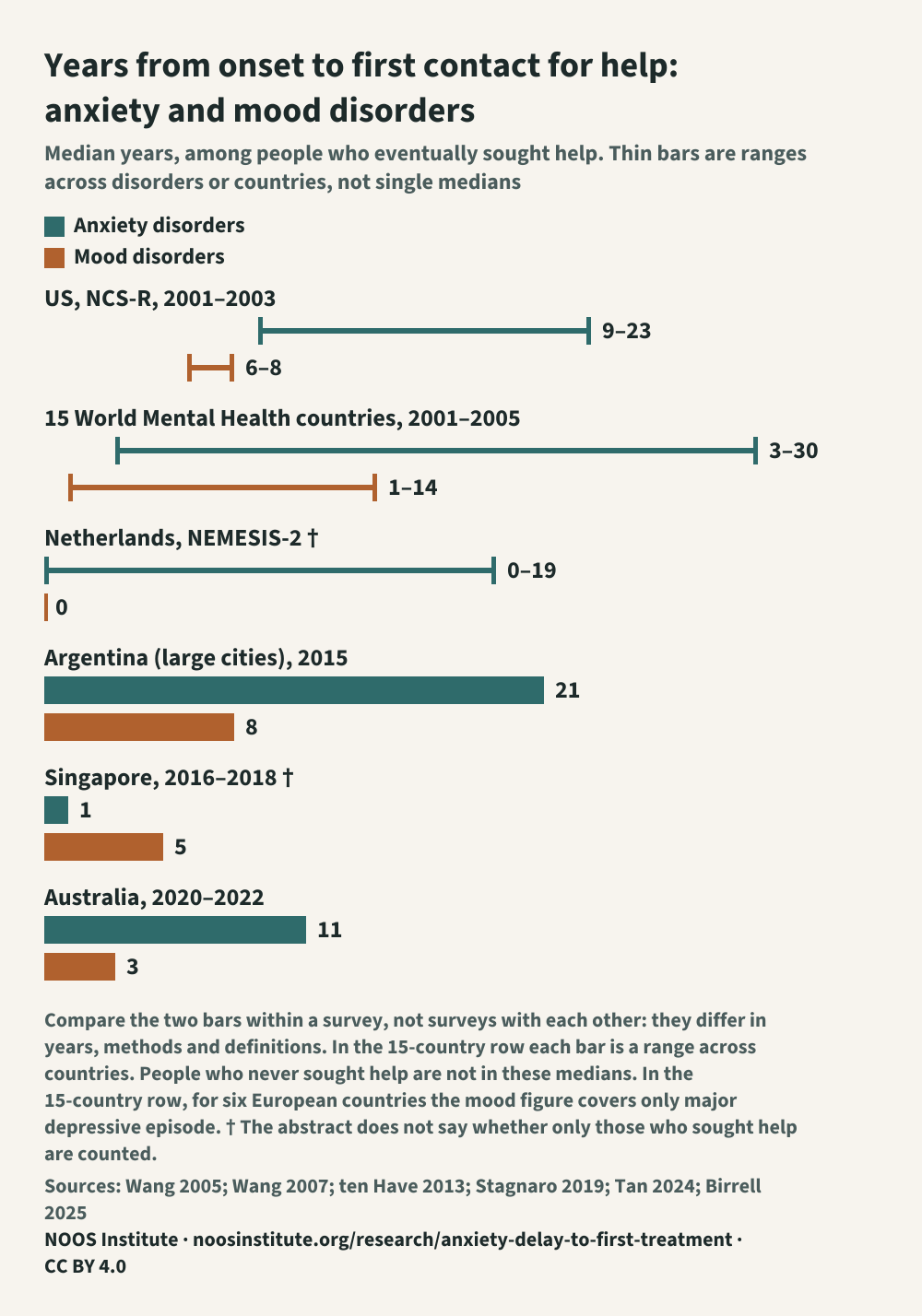
In Australia (2020–2022) and Argentina's large cities (2015), people with anxiety disorders who eventually sought help waited about 3.7 and 2.6 times longer than people with mood disorders; Singapore (2016–2018) shows the opposite, 1 year vs 5. Social anxiety waited 16 years or more in all three surveys we found that give a separate figure for it (the Dutch survey's abstract gives only a range across anxiety disorders) (for two of them it is not stated whether only those who sought help are counted; one is of military personnel). This does not show that anxiety itself causes the delay: only those who sought help are counted, and age of onset, which goes with longer delay and is not separated in any study we found, may explain part of the gap.
What we will not claim
Only people who eventually sought help are counted; people who never did are not in the median. An earlier start of the disorder goes with longer delay (Wang 2005, Birrell 2025; in 15 countries early onset also goes with never seeking help, Wang 2007); no study we found separates age of onset from everything else, so how much of the gap it explains is the main unproven point. There is an opposite case: in Singapore (2016–2018) the median was 1 year for anxiety and 5 for mood disorders, but only 137 people in the survey had ever sought help for a mood, anxiety or alcohol use disorder. The age of onset is recalled years later. Medians are estimated from time-to-contact curves, not observed directly. In the World Mental Health surveys a "professional" is broad: it includes counselors, spiritual advisers and traditional healers. For the Singapore, Netherlands, US NESARC and Canadian military figures, the source abstracts do not say whether the median counts only those who sought help.
If you are in immediate danger, contact local emergency services. For suicidal thoughts, go to iasp.info/suicidalthoughts. Find help
Median years from onset to first contact, among those who eventually sought help
| Survey (country, years) | Anxiety disorders | Mood disorders | Substance use disorders |
|---|---|---|---|
| US, NCS-R, 2001–2003 (Wang 2005) | 9–23 (by disorder) | 6–8 (by disorder) | alcohol abuse 9; alcohol dependence 6 |
| 15 World Mental Health countries, 2001–2005 (Wang 2007) | 3–30 (across countries) | 1–14 (across countries)* | 6–18 (across 13 countries) |
| Netherlands, NEMESIS-2 † (ten Have 2013) | 0–19 (by disorder) | 0 | 0–4 (by disorder) |
| Argentina (large cities), 2015 (Stagnaro 2019) | 21 | 8 | 16 |
| Singapore, 2016–2018 † (Tan 2024) | 1 | 5 | alcohol 4 |
| Australia, 2020–2022 (Birrell 2025) | 11 | 3 | 8 |
Medians among those who eventually sought help, estimated from time-to-contact curves. Ranges are across countries or across individual disorders, as marked. Compare columns within a row, not rows with each other. The 15-country row is an exception: each cell is a range across countries, so it is not a comparison within one survey. * In six European countries this figure covers only major depressive episode. † The source abstract does not state whether the median counts only those who sought help; for the Netherlands it also does not state the survey years.
Download: chart PNG · SVG · data CSV Free to republish with credit: NOOS Institute, CC BY 4.0.
What the delay measures
The delay is the number of years from the age at which a person says their disorder began to the age at which they first contacted a doctor or another professional about it. In the World Mental Health surveys "professional" is broad: psychologists, counselors, spiritual advisers and traditional healers count too. Both ages are recalled in an interview, often years later. The median among those who sought help is estimated from time-to-contact curves: half of the people who eventually sought help waited longer than this. People who never sought help are not in the median at all.
Anxiety vs mood disorders, then and now
In Australia's 2020–2022 national survey, the median delay was 11 years for anxiety disorders and 3 years for mood disorders, about 3.7 times longer (Birrell 2025). In Argentina's large cities in 2015 it was 21 years vs 8, about 2.6 times longer (Stagnaro 2019). The pattern is older than these surveys. In the US in 2001–2003 the medians were 9–23 years for anxiety disorders and 6–8 years for mood disorders, depending on the disorder (Wang 2005). Across 15 World Mental Health countries in 2001–2005, country medians ranged from 3 to 30 years for anxiety disorders and from 1 to 14 years for mood disorders; in six European countries the mood figure covers only major depressive episode (Wang 2007). Mood disorders include depression. There is an opposite case: in Singapore in 2016–2018 the median was 1 year for anxiety disorders and 5 years for mood disorders. Only 137 people in that survey had ever sought help for a mood, anxiety or alcohol use disorder, and the abstract does not say whether the median counts only them (Tan 2024).
People with substance use disorders wait comparably long
Anxiety disorders are not alone in waiting long. In the same Australian survey, the median for substance use disorders was 8 years (10 for alcohol, 4 for drugs), against 11 for anxiety and 3 for mood disorders (Birrell 2025). In Argentina it was 16 years, against 21 and 8 (Stagnaro 2019). Across 13 World Mental Health countries with enough cases, country medians for substance use disorders ranged from 6 to 18 years (Wang 2007). In Australia's 2007 survey, the median delay for alcohol use disorders was 18 years: 14 for dependence and 23 for abuse (Chapman 2015).
Social anxiety
Social anxiety (called social phobia in some surveys) waited 16 years or more in all three surveys we found that give a separate figure for it (the Dutch survey's abstract gives only a range across anxiety disorders). The median was 16 years in the US NCS-R survey of 2001–2003, where specific phobia waited 20 (Wang 2005), 16 years in the US NESARC survey of 2004–2005 (Iza 2013), and 26 years among Canadian military personnel, survey year not stated in the abstract (Fikretoglu 2010). Other anxiety disorders vary by survey. In NCS-R the median was 10 years for panic disorder and 9 for generalized anxiety disorder (Wang 2005); in NESARC most people with panic disorder sought help in the same year it began, and the median for generalized anxiety disorder was 1 year (Iza 2013). Among Canadian military personnel the medians were 8 years for panic disorder and 3 for generalized anxiety disorder (Fikretoglu 2010). The NESARC and Canadian abstracts do not say whether the median counts only those who sought help.
Where the "11 years" figure comes from
The often-quoted "11 years" is a median for all disorders together, not for anxiety alone. It comes from the US National Comorbidity Survey of September 1990 to February 1992 (8,098 people aged 15–54): the time from the start of a person's first disorder to their first contact for treatment, among those who eventually sought help (Wang 2004). It is not split by disorder class. In the Australian survey of 2020–2022, the median for any disorder was 12 years (Birrell 2025).
How this connects to the gap before first contact
Our briefing "Most of the treatment gap for depression, anxiety and substance use opens before people seek help" (listed in the sources below) found that, in a given year, most people without minimally adequate care had not sought help at all. That is a one-year snapshot; this page looks at a lifetime and shows how many years pass before a first contact for those who do make one. Whether anything shortens this time for depression or anxiety has not been tested in any controlled study we found: https://noosinstitute.org/research/depression-anxiety-time-to-help-untested
Sources
- Birrell 2025, Epidemiology and Psychiatric Sciences
- Stagnaro 2019, Epidemiology and Psychiatric Sciences
- Wang 2007, World Psychiatry
- Kessler 2007, World Psychiatry (survey years)
- Wang 2005, Archives of General Psychiatry
- Wang 2005, Archives of General Psychiatry (full text, Table 1)
- Tan 2024, Social Psychiatry and Psychiatric Epidemiology
- ten Have 2013, Psychiatric Services
- Iza 2013, Journal of Clinical Psychiatry
- Fikretoglu 2010, Medical Care
- Chapman 2015, Drug and Alcohol Dependence
- Wang 2004, Health Services Research
- NOOS Institute 2026, Most of the treatment gap for depression, anxiety and substance use opens before people seek help