What we conclude
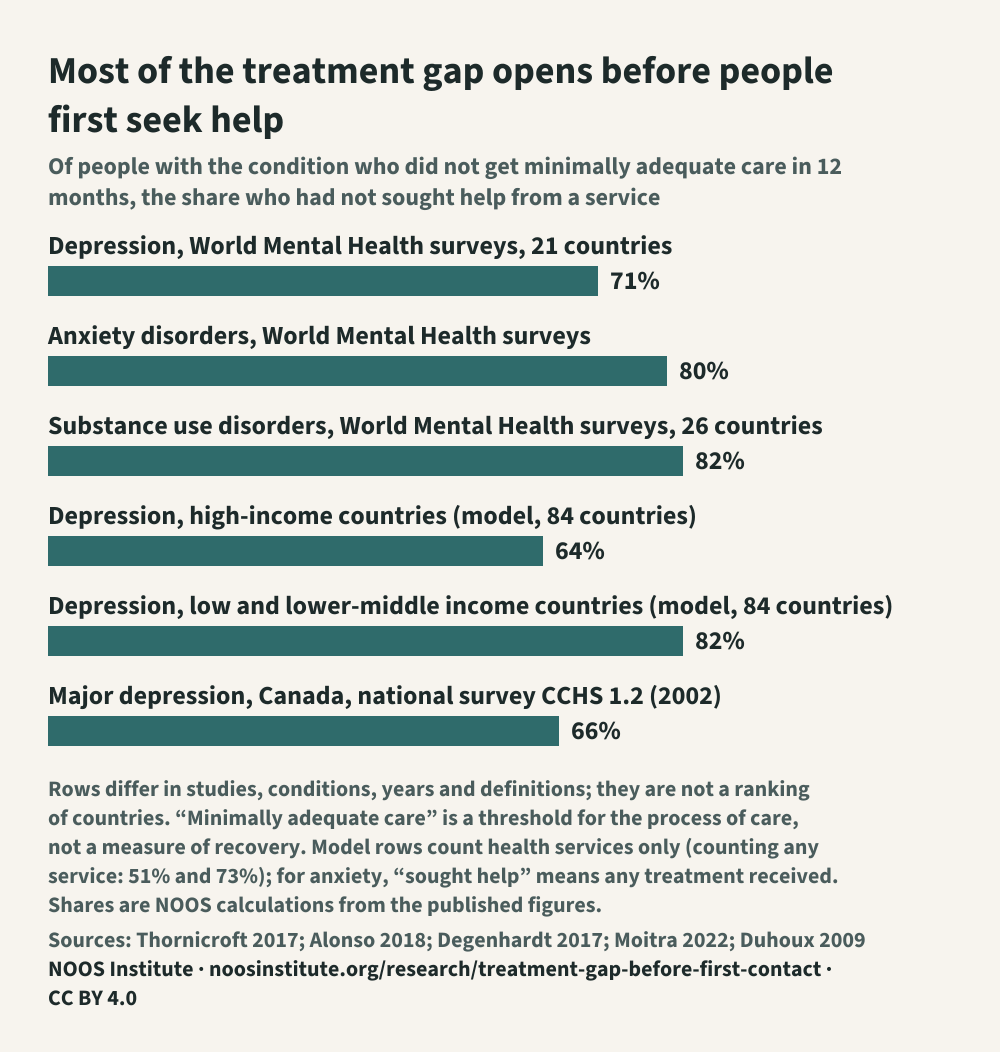
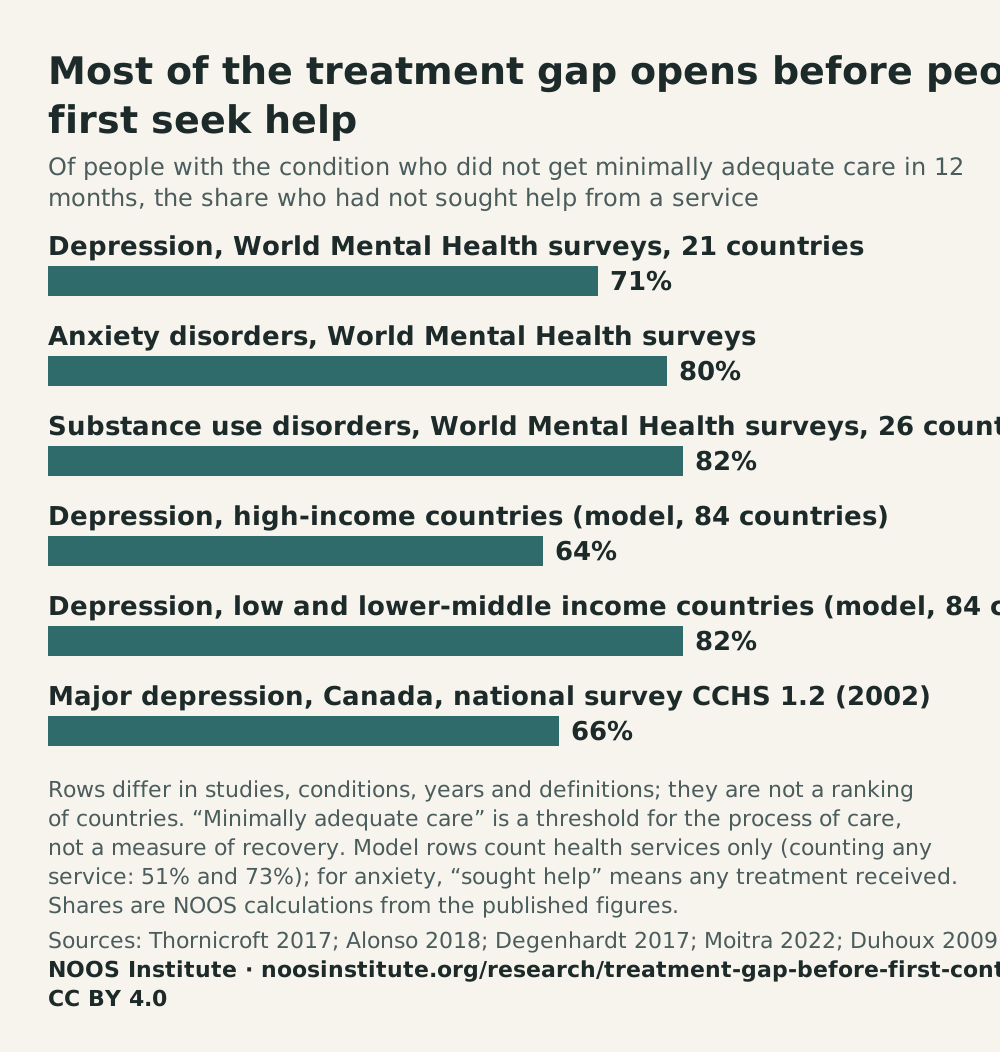
In all six cascades, most people without minimally adequate care had not reached even a first contact: 64% to 82% of the gap opens before that point (51% to 82% if any service, not only health services, counts as first contact in the pooled model). The six cascades come from three groups of sources — three from the World Mental Health surveys, two from one pooled model of 149 studies from 84 countries, and one from a national survey of Canada — and only the Canadian survey is independent of the World Mental Health surveys. The second part is weaker and depends on the country and the definition: among those who did seek help, from 29% to 85% still did not receive minimally adequate care (in Canada, care in line with national guidelines); the low end, 29%, is Canada under the softest definition.
What we will not claim
This is a recalculation of published figures, not a new study. Each cascade is a 12-month snapshot of a population, not one person’s path over time. Seeking help and adequacy come from surveys (in the model, pooled from studies) and are judged by the authors’ thresholds: they measure whether a person received a minimum of care, not whether they got better. Three of the six rows come from the same World Mental Health surveys, and the pooled model may include some of those surveys too. In the pooled model the shares are separate predictions, not nested in each other, so the subtraction is approximate; if any service at all counts as first contact, the share of the gap before first contact is 51% (high-income countries) and 73% (low and lower-middle income) instead of 64% and 82%. The Canadian data are from 2002 and one country, and the denominator of the 55% is not named in the abstract — we infer it from the numbers. The data do not say why people did not seek help or whether care was available to them.
If you are in immediate danger, contact local emergency services. For suicidal thoughts, go to iasp.info/suicidalthoughts. Find help
Six care cascades: where the treatment gap opens
| Cascade | Sought help | Minimally adequate care | Share of the gap before first contact | Share of the gap after first contact | Of those who sought help, without adequate care |
|---|---|---|---|---|---|
| Depression, World Mental Health surveys, 21 countries (Thornicroft 2017) | 40.3% | 16.5% | 71% | 29% | 59% |
| Anxiety disorders, World Mental Health surveys (Alonso 2018) | 27.6% (any treatment) | 9.8% (possibly adequate) | 80% | 20% | 64% |
| Substance use disorders, World Mental Health surveys, 26 countries (Degenhardt 2017) | 24.0% | 7.1% | 82% | 18% | 70% |
| Depression, high-income countries (model, 84 countries) (Moitra 2022) | 51% (health services) | 23% | 64% | 36% | 55% |
| Depression, low and lower-middle income countries (model, 84 countries) (Moitra 2022) | 20% (health services) | 3% | 82% | 18% | 85% |
| Major depression, Canada, national survey CCHS 1.2 (2002) (Duhoux 2009) | 53% (831 of 1,563, unweighted) | ≈29% of all (55% of those who sought help; 48–71% by definition) | 66% | 34% | 45% (29–52% by definition) |
The formulas are given under Method. “Sought help” and “minimally adequate care” are shares of everyone with the condition over 12 months. The two “share of the gap” columns are shares of everyone without minimally adequate care; the last column is a share of those who sought help. Anxiety: “sought help” is any treatment received, and adequacy is the authors’ softer “possibly adequate” threshold. Model rows: “sought help” means health services, and the shares are separate predictions, so the results are approximate. Canada: 831 of 1,563 are unweighted counts; adequate care is care in line with national guidelines, and the denominator of the 55% is not named in the abstract — we take it as those who sought help. “Minimally adequate care” is a threshold for the process of care (visits or length of medication), not a measure of whether a person got better. The rows are not a ranking of countries: they differ in studies, conditions, years and definitions.
Download: chart PNG · SVG · data CSV Free to republish with credit: NOOS Institute, CC BY 4.0.
What “first contact” and “minimally adequate care” mean here
Each cascade follows people who had a condition over the past 12 months through the steps of care: whether they sought help from a service, and whether the care they received reached a minimum level. “First contact” is the step of seeking help at all. In the World Mental Health surveys and the Canadian survey this is reported by the respondents themselves; in the pooled model it means contact with health services.
“Minimally adequate care” is a threshold set by each study’s authors, based on the number of visits or the length of medication. It shows whether a person received a minimum of care. It does not show whether they got better.
What the six cascades show
In every cascade, most of the treatment gap lies before first contact: 71% for depression in the World Mental Health surveys, 80% for anxiety disorders, 82% for substance use disorders, 64% and 82% for depression in high-income and in low and lower-middle income countries in the pooled model, and 66% for major depression in Canada. In other words, among people without minimally adequate care, roughly two thirds or more had not sought help from a service (in the model rows, from health services).
The second step matters too, but it varies more. Among those who did seek help, the share left without minimally adequate care was 59%, 64% and 70% in the World Mental Health rows, 55% and 85% in the model rows, and 45% in Canada.
A separate World Mental Health analysis with a stricter definition — “effective” rather than minimally adequate care — points the same way: of a 90% gap in effective treatment for depression, 58 percentage points were people who did not seek help, and 32 points were care of insufficient quality or care that was not continued.
Canada: a source independent of the World Mental Health surveys
Three of the six rows come from the same World Mental Health surveys, so they do not confirm each other independently. The pooled model of 149 studies from 84 countries adds breadth, but it may include some of the same surveys. The one source independent of the World Mental Health surveys is Canada’s national survey CCHS 1.2 from 2002. In Canada, 831 of 1,563 people with major depression in the past year sought help, and 55% of them received care in line with Canadian guidelines — between 48% and 71%, depending on the definition. The abstract does not name the denominator of the 55%; we read it as those who sought help, because 55% of 1,563 would be more than the number who sought help. On this reading, 66% of the gap lies before first contact, which agrees with the other cascades.
The second part of the finding is weaker for that reason. In Canada, 45% of those who sought help did not receive guideline-level care, and under the different definitions this ranges from 29% to 52% — under the softest one, less than a third. How much care falls short after first contact depends on the country and on where the threshold is drawn.
How little care this is overall
A global estimate puts the share of people with depression who received minimally adequate treatment in 2021 at 9.1% (95% uncertainty interval 7.2–11.6%): 27.0% in high-income countries and 2.0% in sub-Saharan Africa. This estimate is modelled from 32 studies in 31 countries, and a published commentary has questioned whether the data behind it are sufficient.
What these data do not show
They do not follow the same people over time: each cascade is a 12-month snapshot, so it cannot say how long people wait before seeking help or what happens to them later. They do not explain why people did not seek help. This page has no figures for Russia. What happens after the first contact is a separate question: our briefing on NHS Talking Therapies in England shows that a standard met at the first appointment can hide long waits for the second.
Sources
- Thornicroft et al. 2017, British Journal of Psychiatry — depression care cascade, World Mental Health surveys
- Alonso et al. 2018, Depression and Anxiety — anxiety disorders treatment, World Mental Health surveys (table 2)
- Degenhardt et al. 2017, World Psychiatry — substance use disorders care cascade, World Mental Health surveys
- Moitra et al. 2022, PLoS Medicine — depression care cascade, 149 studies, 84 countries (table 5)
- Duhoux et al. 2009, Social Psychiatry and Psychiatric Epidemiology — major depression care in Canada, CCHS 1.2
- Vigo et al. 2022, Psychological Medicine — effective treatment gap for depression, World Mental Health surveys
- Santomauro et al. 2024, Lancet Psychiatry — global coverage of minimally adequate treatment for depression, 2021
- Lancet Psychiatry 2024 — commentary on the global estimate
- NOOS Institute 2026, NHS Talking Therapies waiting times: 20–25% who reach a second appointment wait over 90 days for it