What we conclude
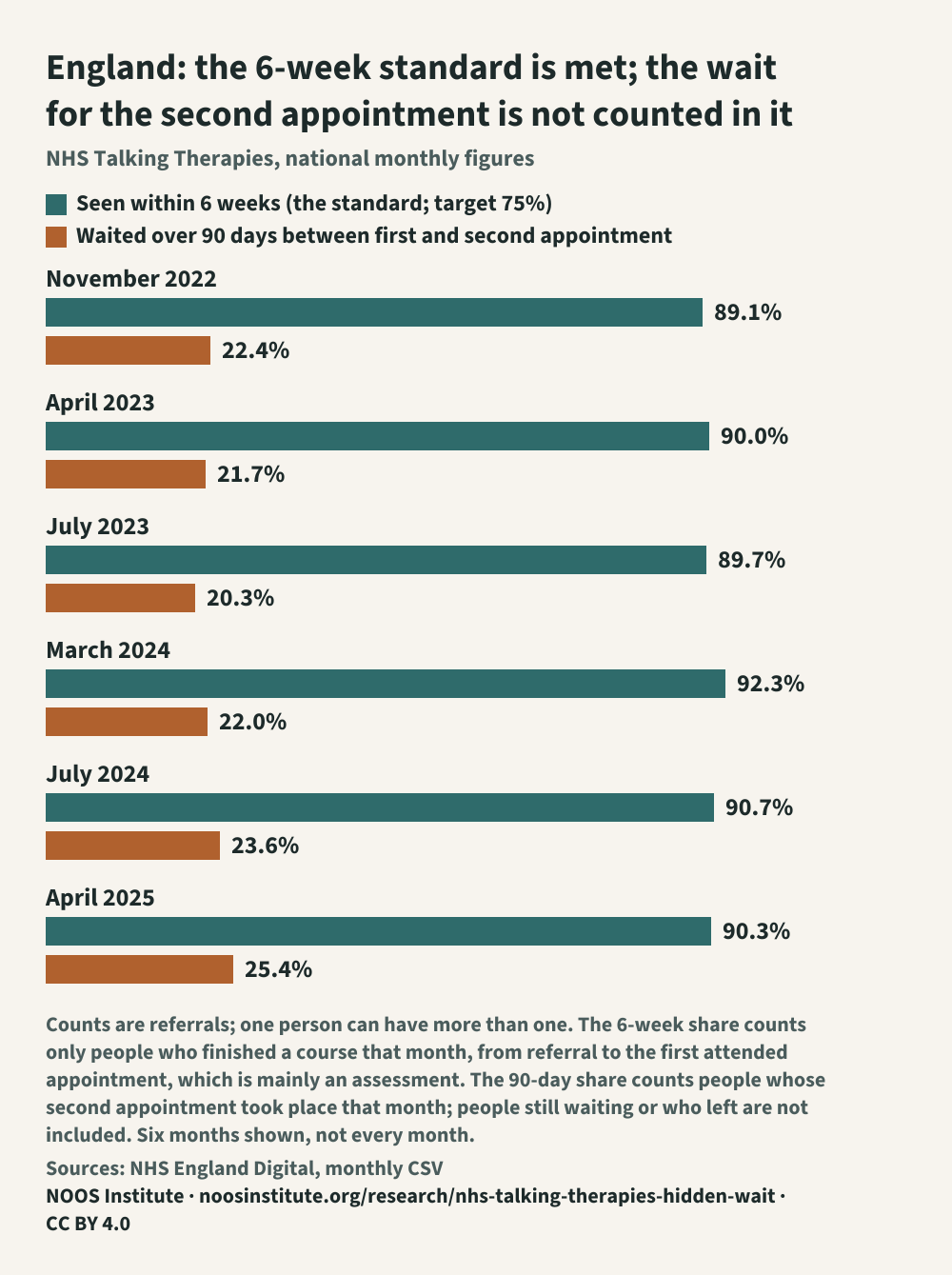
In England, the waiting-time standard for NHS Talking Therapies (75% within 6 weeks, 95% within 18) counts the wait from referral to the first appointment, mostly an assessment, and services meet it: 89–92% within 6 weeks in the months we read. After that first appointment, between one in five and one in four of the people who reached a second appointment had waited more than 90 days for it: 22.4% in November 2022, 25.4% in April 2025. More than half had waited over 28 days (52–64%). In April 2025, the average wait from assessment to the first session of the more intensive therapy was 72 days. The standard does not see these waits.
What we will not claim
The 90-day share counts only people who had a second appointment in the month; people who gave up while waiting are not in it, so it does not show how many were lost. For some people the first appointment already includes treatment, so for them the gap is a pause in treatment rather than a wait for it to start; the data do not say which. These are national figures for one service in one country, for six months we could read, not every month. Areas and providers are not compared here. We did not show here whether a long wait after the first appointment makes people more likely to drop out or recover less. We do not claim the figure was unknown: NHS England publishes it; it is just not part of the standard.
If you are in immediate danger, contact local emergency services. For suicidal thoughts, go to iasp.info/suicidalthoughts. Find help
England, NHS Talking Therapies: the standard and the wait for the second appointment
| Month | Seen within 6 weeks (the standard; target 75%) | Waited over 28 days between first and second appointment | Waited over 90 days between first and second appointment | Average days from assessment to first higher-intensity therapy session |
|---|---|---|---|---|
| November 2022 (NHS England Digital, monthly CSV) | 89.1% | 53.6% | 22.4% (14,002 of 62,556) | not in this file |
| April 2023 (NHS England Digital, monthly CSV) | 90.0% | 60.2% | 21.7% (11,093 of 51,192) | 60.2 |
| July 2023 (NHS England Digital, monthly CSV) | 89.7% | 52.5% | 20.3% (12,167 of 60,061) | 61.2 |
| March 2024 (NHS England Digital, monthly CSV) | 92.3% | 58.4% | 22.0% (11,164 of 50,632) | 62.6 |
| July 2024 (NHS England Digital, monthly CSV) | 90.7% | 59.2% | 23.6% (14,741 of 62,584) | 68.4 |
| April 2025 (NHS England Digital, monthly CSV) | 90.3% | 64.0% | 25.4% (14,481 of 57,079) | 72.0 |
National figures from NHS England's monthly data files. Counts are of referrals; one person can have more than one referral. Waits from assessment are averages (means), not medians, so the longest waits pull them up. "Seen within 6 weeks" counts people who finished a course of treatment that month, from referral to first attended appointment. The two wait columns count people whose second appointment took place that month; people still waiting or who left before a second appointment are not included. The average wait from assessment to higher-intensity therapy was not in the November 2022 file. Six months are shown because these are the files we could read in the archive; the months between them are not shown.
Download: chart PNG · SVG · data CSV Free to republish with credit: NOOS Institute, CC BY 4.0.
What the standard counts
NHS Talking Therapies is the NHS service in England for anxiety and depression; people can refer themselves. Its waiting-time standard says that of the people who have a course of treatment (two or more sessions), 75% should have their first session within 6 weeks of referral and 95% within 18 weeks. NHS England's manual for the service describes that first session as "primarily assessment". The monthly reports count the standard the same way: from referral to the first attended appointment, among people who finished a course of treatment that month. In the months we read, 89–92% were seen within 6 weeks.
The wait after the first appointment
The same monthly data files also count how long people waited between their first and second appointments; by July 2024 NHS England itself was publishing the over-90-day share as a percentage in these files. The wait is published, but it is not part of the standard. Among people who had a second appointment in the month, the share who had waited more than 90 days was 22.4% in November 2022 (14,002 of 62,556), 21.7% in April 2023, 20.3% in July 2023, 22.0% in March 2024, 23.6% in July 2024 and 25.4% in April 2025 (14,481 of 57,079). The share who had waited more than 28 days was between 52.5% and 64.0%; April 2025 had the highest share on both measures of the months we read. From April 2023 the files also give the average wait from assessment to the first session of each kind of therapy: in April 2025 it was 7.6 days for lower-intensity support such as guided self-help and 72.0 days for higher-intensity therapy such as cognitive behavioural therapy with a therapist.
NHS England names the problem
The service manual warns against "artificial treatment starts where patients have an early appointment but are then put on an 'internal' waiting list before a full course of treatment starts", and asks services to watch "waiting times from first to second treatment appointment". It says there should be no avoidable delays after initial appointments. A study of two NHS Talking Therapies services over two years (45,401 and 12,590 referrals) by authors from the University of Bath and the company Mayden (the paper declares a conflict of interest) found the wait for higher-intensity cognitive behavioural therapy to be a bottleneck at one of them (Yardley et al. 2024).
What does not fit
This is not a finding that the NHS misses its standard: it meets it with room to spare, and the 90-day share was between 20.3% and 25.4% in the six months we read, lowest in July 2023 and highest in April 2025; six months are too few to show a trend. A 2023 report by Future Care Capital put the figure for October 2022 at 24% (13,599 people); the October 2022 file is not in the archive, and the nearest month we could read, November 2022, gives 22.4%. NHS England's annual report for 2024–25 also reports this wait; we could not open it, so its figures are not used here.
How this connects to our other findings
Our briefing "Most of the treatment gap for depression, anxiety and substance use opens before people seek help" showed that most people who go without care are lost before the first contact. This page looks at the other side of the door: people who did get in, were assessed and then waited. A standard that stops at the first appointment can be met in full while one in five to one in four of those who reach a second appointment wait more than three months for it. This page is research, not advice: if things get worse while you are waiting in England, call 111 and select the mental health option, or 999 if a life is at risk.
Sources
- NHS England Digital, NHS Talking Therapies monthly data, November 2022 (CSV)
- NHS England Digital, NHS Talking Therapies monthly data, April 2023 (CSV)
- NHS England Digital, NHS Talking Therapies monthly data, July 2023 (CSV)
- NHS England Digital, NHS Talking Therapies monthly data, March 2024 (CSV)
- NHS England Digital, NHS Talking Therapies monthly data, July 2024 (CSV)
- NHS England Digital, NHS Talking Therapies monthly data, April 2025 (CSV)
- NHS England Digital, NHS Talking Therapies metadata 2022-23: measure definitions (XLSX)
- NHS England Digital, monthly report March 2024: Waiting Times
- NHS England, NHS Talking Therapies Manual v7 (2018, updated 2024)
- Yardley et al. 2024, JMIR Mental Health
- NHS, Where to get urgent help for mental health
- Future Care Capital 2023, Left in limbo on hidden waiting lists
- NOOS Institute 2026, Most of the treatment gap for depression, anxiety and substance use opens before people seek help